Visar inlägg med etikett made up words. Visa alla inlägg

onsdag 26 augusti 2015

The Meaning of Pluggers, part 29

Pluggers, 20150826:
Today, "Plugger" means "Over two hundred years old".

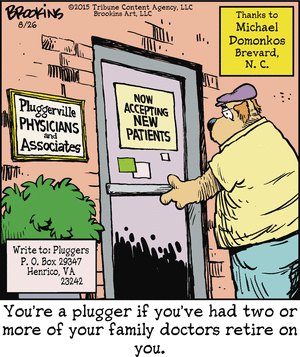
Well, there's definitely some generational gap here. I've heard of family doctors (though not once in a context of them not being a hilariously old-fashioned concept), but I've no idea why Mr Dog is terrified to see he may meet new people in the waiting room, aside from the basic fear of change.

Do pluggers even visit clinics? I think family doctors are supposed to visit you at home.

But I'm fairly sure if you had one doctor, then got a new one when the old one died, then had that one for the duration of his entire career, and all this happened back when people had a family doctor, and you're still alive now, that'd make you at least two hundred years.

Why does "Plugger" so often mean "Old"? Consider the main writer of the strip: A gestalt of the collective newspaper reader, expressed outwardly as its level of enthusiasm for reading the newspaper. The meaning of Pluggers shows demonstrably that newspapers need to attract a younger readership if they're going to avoid the fate of the dinosaurs.

Your humble critic's plugger status: I'm not, nor could I ever have been, nor will I ever be a plugger today.

onsdag 12 augusti 2015

Demons gotta die baby

This part of page 25 of Kill Six Billion Demons is not really indicative of the comic:
But it's a hard comic to fit within the margins of this poorly designed blog.

If I had to use one word to describe it, the word that springs to mind is "bold". It's a young webcomic - I went through the story so far in a few hours of reading, and I'm not a fast reader - and I'm not yet sure what it's about.

It seems to be about a young woman with dyed blonde hair whose very special night with her boyfriend is interrupted when a mysterious stranger shows up, shoves a brilliantly glowing key into her forehead and gets beheaded by the army chasing him (approximately in that order), which separates her skin, flesh, bones and vascular system from each other with explosive force and then puts her together in a strange place called Throne, populated by criminals, conquerors, avengers, knights, demons, angels, gods, supergods and dead hobos; made out of the corpses of the primordial creator YISUN and their servants, situated at the very heart of the world's 777 777 universes and overflowing with its own wild, spiraling, freight train-like in its self-assurance mythology, where she bumps into the angel 82 White Chain Born in Emptiness Returns to Subdue Evil and the two of them, bound to each other by debt and honor, are set by some circumstance on a mission to, well.

It's a city crawling with life in so many different shapes and sizes it boggles the mind. You'd think it doesn't matter so much, but the ubiquitousness of characters (and two-legged backdrops) that fall deeply into extremes between the bite-sized and the skyscraper-sized has a big effect. The human mind is only comfortable with a certain scale of things, and here we're never even certain what the frame of reference is by which we're supposed to judge the scale. It'd dizzying, baffling, even frightening; it makes you hesitate to look close, contrary to what you need to do to have any chance of grasping what's going on.

The author known only as Abaddon employs a loose, scribbling art style, as seen above. The linework does its job; the colors seem chosen for efficiency more than aesthetic. This, in my opinion, is the work of someone who has things to do and people to be; a furious, relentless march to pour as much of this strange world onto the page as fast as possible. This is the work of someone with complete confidence in the quality of their story, the validity of their worldbuilding, the authenticity of their characters.

Which also shows in the assorted psalms, spasms, parables and historical texts that accompany most pages as an extension of the narrative intermixed with glib comments on the story by the author. Not to mention how they're quite open about making up the story and the characters as they go along and invite the reader to contribute.

It's really a lot of information to take in, and Abaddon doesn't make it easy for the reader. I like that. Nothing worse than an author what underestimates their audience. It gets frustrating when you catch up with the comic to date and there are still so few answers, but then, that's serial publication for you.

I like the world and its people. I hate sleeping because I'm always missing stuff. Kill Six Billion Demons is one of those comics that make me wish I could sleep for years so I don't have to wait to find out what happens. But then, that'd only mean it'd be too late to be a part of it.
onsdag 5 augusti 2015

The Meaning of Pluggers, part 10

Pluggers, 20150805:
Today, the para-stable matrix of the hyperword "Plugger" returns to meaning "Old".

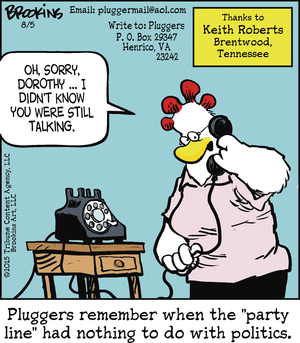
Maybe not as old as Keith Roberts thinks, though. We had party lines when I was a teenager in the 1990s. I called them with our rotary, bakelite phone. I'd have guessed they died out with the advent of fiberoptics, but it turns out they still exist. Just not in your big city-centric reality. What, you thought the subway map marked the edge of the civilized world? Turns out there are still people living out there, and I'm not even talking about suburbs. I'm talking about isolated communities deep in the wilderness where you'd have to vespa for days to get a wireless connection.

Or, wait, maybe I'm reading this wrong and it's not about the cultural isolation of the incestuous Pluggers author/readership where they come to think something as blatantly unthoughtful as "Where did those party lines we used to have before we moved to the city go?" is a universally shared thing that everyone of their generation is thinking. Maybe it's about being so old you start believing your party's lines and actually value their rhetoric over their demonstrated interests, competence or integrity; that quoting a good-sounding soundbite is better than doing useful things like let's say keeping people from starving to death in the street.

I've seen that level of oldness. It's not pretty. But it's perfectly in line with what we expect from Pluggers.

Your humble critic's plugger status: Probably negative, sadly.

tisdag 28 juli 2015

The Meaning of Pluggers, part 2

Pluggers, 20150728:

Today, "Plugger" means "Old".

In the Pluggers hyperdictionary-in-motion of the single word "plugger" (I don't really want to call it a comic strip), the unpredictably shifting meaning often tends towards "old".One might even think of it as a default state.

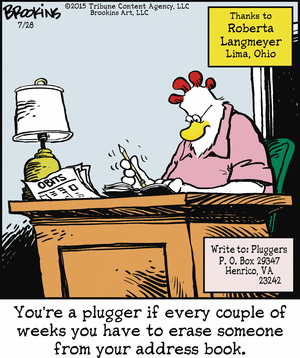
But in my ongoing efforts to understand Pluggers, I've come to think it's more subtle than that. It's never just "old", or "Generation X working class" or anything so unspecific. Today's definition, for instance, implies that particularly advanced state of oldness where all one's old friends seem to die left and right.

And yet Mrs Chicken here is young enough to still deny her own mortality. She rubs out the names of her childhood friends with the fervent desire to forget them and move on, clinging to, nurturing the certainty it'll never happen to her.

I mean my mom died in 2012 and I have since copied her cell number to two new phones. It would be, as Neil Gaiman put it, too final a farewell. To let the memories fade, to try so hard to stay alive you forget why you live, forget to stay human, no. I won't do that.

Your humble critic's plugger status: Negative